

Fridge running but food isn't cold enough? Start with these 3 DIY checks: (1) vacuum the condenser coils under/behind the unit, (2) check the door gasket seal — close a dollar bill in the door, if it slides out easily the gasket needs replacing, (3) verify the thermostat is set to 37°F. If none of these help, it's likely a bad evaporator fan or thermostat ($150–$300 repair).
You open the fridge and everything feels lukewarm. The motor is humming, the light comes on, but your milk is warm and your lettuce is wilting. A refrigerator that runs but doesn't get cold enough is one of the most common — and most urgent — appliance problems we see across Port St. Lucie and the Treasure Coast. The good news: most causes are fixable without replacing the entire unit.
Check this first:
Make sure the thermostat dial inside the fridge hasn't been bumped to a warmer setting. Also check that nothing is blocking the air vents inside the fridge — a gallon of milk pushed against the rear vent is responsible for roughly 15% of "not cold enough" calls we receive.
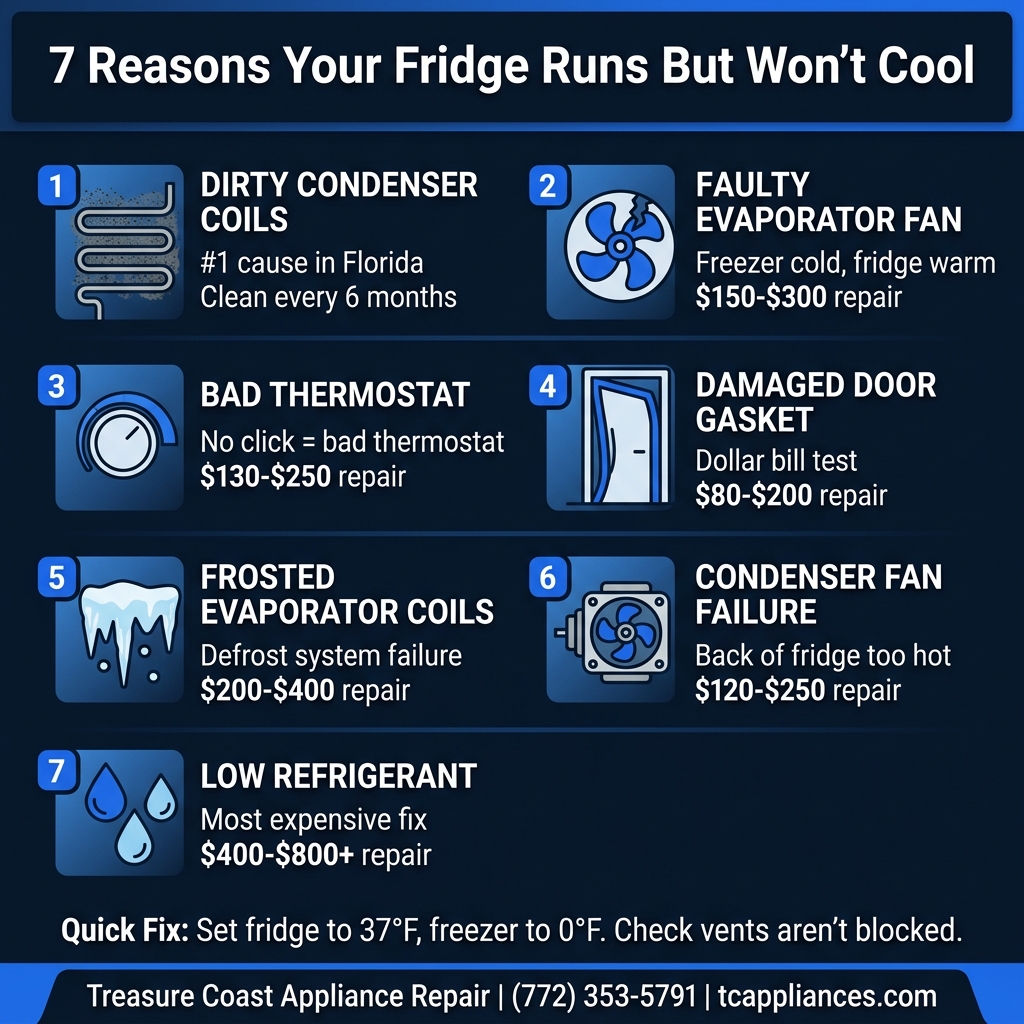
Quick visual guide: 7 causes of a fridge that runs but won't cool, with repair cost ranges
1. Dirty Condenser Coils (Most Common in Florida)
Your refrigerator's condenser coils dissipate heat from the refrigerant. When they're caked with dust, pet hair, and debris, the system can't release heat efficiently and the fridge struggles to maintain temperature. In Florida's year-round heat and humidity, this is the #1 reason refrigerators lose cooling power — the compressor is already working harder than it would in cooler climates.
Fix: Pull the fridge away from the wall, locate the coils (usually on the back or underneath), and vacuum them with a brush attachment. We recommend doing this every 6 months in Florida. If you're not comfortable doing this yourself, a professional refrigerator service call includes a thorough coil cleaning.
2. Faulty Evaporator Fan Motor
The evaporator fan circulates cold air from the freezer into the refrigerator compartment. If this fan motor fails, the freezer may still be cold but the fridge side will be warm. You might notice unusual buzzing or humming sounds, or complete silence when you open the fridge door (the fan should stop when the door opens and restart when it closes).
Cost to fix: $150–$300 depending on the brand. Samsung and LG evaporator fans tend to cost more than Whirlpool or GE. This is a common failure point on French door refrigerators after 3–5 years.
3. Malfunctioning Thermostat
The temperature control thermostat directs voltage to the compressor, evaporator fan, and condenser fan. If it's defective, it may not signal the cooling system to run frequently enough, resulting in a fridge that's always a few degrees too warm.
How to test: Turn the thermostat from the lowest to the highest setting. If you hear a click, it's likely working. No click? The thermostat may need replacement ($130–$250).
4. Damaged Door Gasket (Seal)
The rubber gasket around your fridge door creates an airtight seal. Over time, gaskets crack, warp, or lose their magnetic grip — especially in Florida's UV-heavy environment if your fridge is near a window or in a garage. When warm, humid air leaks in, your fridge has to work overtime and may never reach the right temperature.
The dollar bill test: Close the fridge door on a dollar bill. If you can pull it out easily without resistance, your gasket needs replacing. Cost to fix: $80–$200 for the gasket plus installation.
5. Frosted Evaporator Coils (Defrost System Failure)
Modern refrigerators have an automatic defrost system. If the defrost heater, defrost thermostat, or defrost timer fails, ice builds up on the evaporator coils and blocks airflow. The freezer may still seem cold, but the fridge compartment gets progressively warmer.
Signs: Ice buildup on the back wall of the freezer, the fridge cycling between cold and warm, or a clicking sound near the back. Cost to fix: $200–$400 for defrost system repair.
6. Condenser Fan Motor Failure
The condenser fan (located near the compressor at the bottom-rear of the fridge) helps cool the condenser coils and compressor. If it stops working, heat can't escape and the fridge gradually warms up. This is a critical component in Florida homes where ambient temperatures are already high.
Cost to fix: $120–$250. If your fridge is louder than usual or the back feels excessively hot, this may be the cause.
7. Low Refrigerant (Sealed System Leak)
This is the most serious and expensive possibility. If your refrigerator has a refrigerant leak in the sealed system, it will gradually lose cooling capacity over weeks or months. You'll notice the fridge getting warmer and warmer despite no other visible issues.
Cost to fix: $400–$800+ for sealed system repair. At this price point, it's worth considering whether repair or replacement makes more sense, especially if your fridge is over 10 years old.
Frequently Asked Questions
Why is my refrigerator running but not cold enough?
The most common causes are dirty condenser coils, a malfunctioning evaporator fan, a faulty thermostat, or blocked air vents inside the fridge. In Florida's heat, dirty condenser coils are the #1 culprit because they work overtime to dissipate heat.
How much does it cost to fix a refrigerator that's not cooling properly?
Most refrigerator cooling repairs in Port St. Lucie cost between $150 and $400. A condenser coil cleaning runs $80–$150, while a thermostat or fan motor replacement costs $150–$350 depending on the brand.
Should I replace my refrigerator if it's not cooling well?
Not necessarily. If your fridge is under 10 years old and the repair cost is less than 50% of a new unit, repair is almost always the smarter choice. Most cooling issues are caused by inexpensive parts like fan motors, thermostats, or dirty coils.
Can Florida heat cause my refrigerator to stop cooling?
Yes. Florida's high ambient temperatures — especially in garages — force your refrigerator's compressor to work harder. Combined with dirty condenser coils or poor ventilation, this can cause the fridge to lose cooling capacity. Keep your fridge in air-conditioned spaces and clean the coils every 6 months.
Fridge Not Cold Enough? We Can Fix It Today.
Same-day refrigerator repair across Port St. Lucie, Stuart, Palm City, Jensen Beach & Fort Pierce. All brands serviced.
Related Articles
Parts & Tools You Might Need
If you're tackling this repair yourself, here are the most commonly needed parts. As an Amazon Associate, we earn from qualifying purchases.
- Refrigerator Condenser Coil Brush Clean condenser coils to restore cooling — #1 DIY fix
- Refrigerator Thermometer Verify your fridge is at the right temperature (35–38°F)
- Universal Refrigerator Water Filter (Samsung/LG/Whirlpool) Replace every 6 months for clean water and ice
- Appliance Repair Multimeter Test electrical components before calling a pro
- Handheld Vacuum for Appliance Cleaning Compact vacuum for cleaning coils, vents, and tight spaces
Need Refrigerator Repair in Port St. Lucie?
Same-day service, 90-day warranty, all major brands. Call now or book online.
View Refrigerator Repair Services →